In this article 10
Definition of Digital Marketing
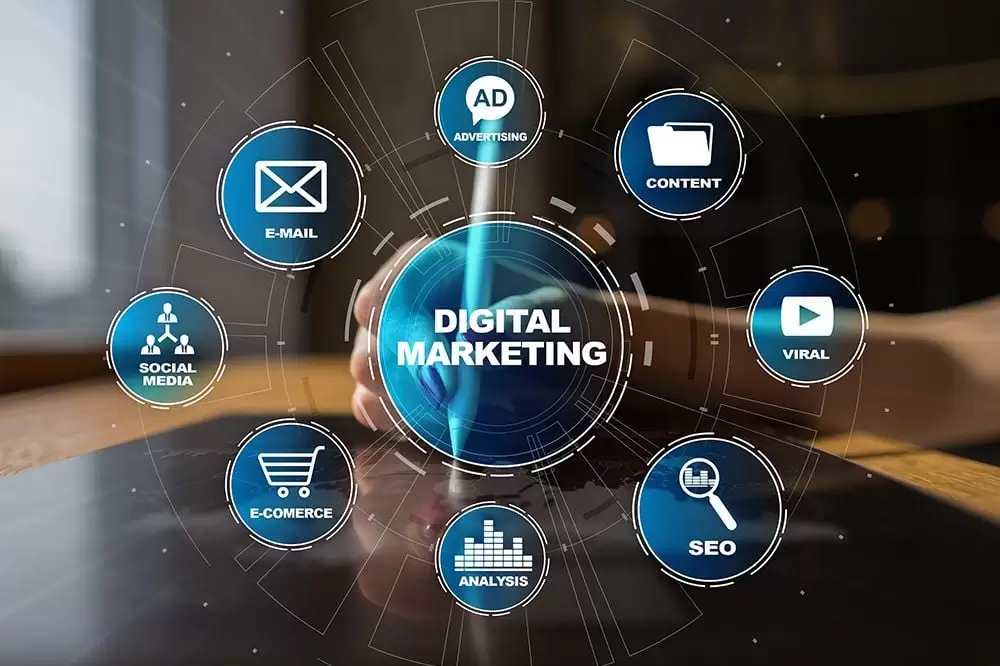
Digital Marketing encompasses a variety of strategies and tools. These include Search Engine Optimization (SEO), social media platforms, paid advertisements (Google Ads, Facebook Ads, etc.), email marketing, content marketing, and analytical tools. The goal is to reach the target audience at the right time and through the right channel, capturing their attention and ensuring the product is promoted with maximum efficiency.
What are the Types of Digital Marketing?
- SMM (Social Media Marketing)
- SEO
- SEM (Google Ads)
- Email Marketing
- Influencer Marketing
- Affiliate Marketing
Digital Marketing - SMM (Social Media Marketing)
What is Social Media Marketing (SMM)
Social Media Marketing (SMM) is an integral part of digital marketing strategies in the modern era. This approach aims to promote products and services, increase brand awareness, and build interactive connections with customers through various social media platforms.
The Main Goal of SMM
The primary goal of SMM is to reach active users on social media platforms, attract their interest, and convert these connections into sales. Social networks are ideal tools for enhancing customer loyalty and strengthening brand image.
Social Media Platforms
- Facebook: The largest social platform in the world. Brands can engage with customers here through advertising campaigns and community building.
- Instagram: This platform, where visual content has a strong impact, is ideal for the appealing presentation of products and services.
- LinkedIn: Primarily used for B2B connections, it is suitable for reaching a professional audience.
- TikTok: A rapidly growing platform targeting a younger audience with short and creative videos.
- Twitter: Brands can demonstrate their relevance and dynamism by responding to daily events here.
How to Create an SMM Strategy?
- Identify the Target Audience: Analyze the demographic and psychographic data of your customers.
- Choose the Platform: Determine the most suitable social media platform for your product or service.
- Set Goals: Define objectives such as brand promotion, increasing sales, or strengthening customer loyalty.
- Content Planning: Create engaging and relevant content, including images, videos, infographics, and posts.
- Analyze Performance: Use analytical tools to measure and optimize the results of your campaigns.
What Should Social Media Content Be Like?
Effective social media content should reflect the brand's style and values while capturing the users' attention. Content should:
- Be composed of appealing visual materials.
- Be short and easy to understand.
- Encourage users to take action (e.g., "Buy Now," "Leave a Comment").
Digital Marketing - SEO (Search Engine Optimization)
What is SEO (Search Engine Optimization)?
SEO (Search Engine Optimization) refers to the set of strategies and techniques applied to help websites rank higher in search engine results. The primary goal of SEO is to increase organic (non-paid) traffic, capture users' attention, and acquire more customers.
What is SEO and Why is It Important?
SEO is the optimization process that ensures users can find your website on search engines like Google, Bing, or others based on specific keywords.
Its main objective is to make your website more visible, provide users with valuable content, and achieve business goals. In today's digital world, competing without SEO is almost impossible.
Key Benefits of SEO
- Build Trust and Credibility:
Higher rankings on search engines increase user trust. - Sustainable Results:
SEO results are long-lasting and ensure consistent traffic with the right approach.
Types of SEO
SEO is divided into two main categories:
- On-Page SEO:
Includes optimization tasks performed within the website.- Proper use of keywords, content quality, meta descriptions, titles, and URL structures.
- Off-Page SEO:
Covers tasks performed outside the website.- Building backlinks, social signals, and gaining links from other websites to yours.
How to Create an SEO Strategy?
- Keyword Research:
Identify the main keywords users search for. Use tools like Google Keyword Planner and Ahrefs to find relevant keywords. - Content Creation:
Create high-quality and valuable content based on keywords. Blog posts, articles, and video content are invaluable for attracting users. - Technical SEO:
Ensure the website's speed, mobile-friendliness, and proper indexing. Mobile-friendly websites rank higher on search engines. - Link Building:
Gain links from other reputable websites to your site. This boosts your website's credibility. - Analytics and Monitoring:
Use tools like Google Analytics and Google Search Console to measure the effectiveness of your SEO efforts.
Measuring SEO Success
To evaluate the effectiveness of an SEO strategy, the following metrics are used:
- Organic Traffic: The number of visitors to your website.
- Keyword Rankings: Your website's position in search results for key keywords.
- Conversions: Turning traffic into sales or other desired outcomes.
- Bounce Rate: The percentage of users leaving your site shortly after entering.
What is Digital Marketing?
Digital Marketing combines all marketing activities across digital channels (site, social, search, email, mobile) to reach customers and convert to sales.
Channels
SEO, SEM (Google Ads), SMM, Content, Email, Affiliate, Influencer, Mobile, Display, Video.
Channel by business
| Business | Main channels |
|---|---|
| Restaurant | Instagram, Google Maps, TikTok, delivery |
| E-commerce | SEO, Google Ads, Facebook, email |
| B2B/SaaS | SEO, LinkedIn, content |
| Local service | Maps, Facebook, SMM |
| Luxury | Instagram, influencer, video |
2026 trends
- AI-powered content
- Video-first
- Voice search
- Privacy-first marketing
- Micro/nano influencers
- Personalization
Metrics
- CTR, CPC, CPA, CPL, ROAS, LTV, Conversion rate
Next step
How a 166 Tech project works
- Free consultation (30 min) — via WhatsApp or call. We learn your requirements, business processes, target audience.
- Technical specification — detailed document covering every screen, function, integration. Protects both of us — no surprises.
- Design & prototype — interactive Figma prototype. You see how it looks and works before any code.
- Iterative development — new functionality every 2 weeks. Live staging environment — your feedback helps us.
- Testing & training — full QA before launch, then user training.
- Launch + support — go-live together. Then 3-6 months free technical support.
Why 166 Tech?
- 100+ completed projects across restaurants, clinics, e-commerce, ERP, mobile apps, corporate sites
- Google Partner certified — based on real performance only
- Full-stack team — UX, frontend, backend, mobile, DevOps, SEO, content — all under one roof
- You own everything — code, design, data — no lock-in
- 3-language support — Azerbaijani, Russian, English
- Ongoing relationship — Q&A and minor fixes after delivery
FAQ
How long does a project take?
Simple site 7-30 days, corporate site 30-60 days, ERP/CRM 2-6 months, mobile app 2-4 months. We give exact timeline after reviewing your spec.
Why custom instead of off-the-shelf?
SaaS solutions (Bitrix, Shopify, WordPress) cover 80% of standard cases. But the 20% that doesn't fit is what makes you different from competitors. Custom invests in that 20%.
What about post-launch support?
3-6 months free support is included. After that, monthly SLA (critical bugs = 4 hours, minor fixes = 24 hours).
How do I get a quote?
Send your requirements via WhatsApp or call +994 50 224 73 00. After a 30-minute free consultation we provide an exact quote and timeline.
Will my site rank in Google after launch?
All our sites ship with technical SEO done: schema.org, hreflang, sitemap, Core Web Vitals optimization. Ranking still requires ongoing content and link-building — covered by our SEO services.
Get an exact quote
Every project is unique. For a precise quote we need to look at your specific business.
Fastest way — WhatsApp: describe your needs, we respond within 30 minutes.
📱 WhatsApp: +994 50 224 73 00
📞 Phone: +994 50 224 73 00
✉️ Email: info@166tech.az